
Fifteen Years After They Fired Me for Stealing the Señora's Jewelry, She Made Me Empty My Bag in Front of Forty Guests. Then the Mayor Put Down Her Speech...
PART 1: The Mango Tree
The agency does not tell you the address until you are in the van.
That is not cruelty. It is because girls drop jobs when they hear which houses, and Bituin Catering has been burned before.
So I was already in Malinao, already in the uniform, already holding my hairnet in my lap, when Sir Boyet read out the name.
Villafuerte.
I did not say anything.
Fifteen years I have not said anything. I am very good at it now.
Everyone calls me Perla.
For eleven years before that afternoon I worked in that house, and I know which stair creaks and I know the señora takes her coffee at ten and not before.
I also know that in 2011 they said I stole her jewelry, and that after a house says that about you in a town this size, no other house will have you.
Not one. Not in fifteen years.
I have cleaned fish. I have folded plastic. I have done catering for six years, which is the only work left where nobody asks for a character reference because nobody expects you to come back.
The van turned in at the gate and I saw the mango tree.
It was smaller when I planted it.
"Ate Perla." Marilou beside me. She is twenty-three. "Ang laki."
"Yes," I said.
"You know this place?"
"A little."
We went in through the service door. It is the same door. The paint is different.
Señora Amparo Villafuerte came into the kitchen at four o'clock to count the chafing dishes, because she has counted things her whole life.
She stopped.
She looked at me for a long time.
I kept my hands in the sink.
"Well," she said.
The room got very quiet. Sir Boyet was looking between us.
"Ma'am," I said.
"You have some nerve."
"The agency sent me po. I did not know it was your house."
"Of course you did not." She turned to Sir Boyet. "Do you know who you have brought into my home?"
Sir Boyet did not know. He is a decent man. His face went through several things.
"Ma'am, if there is a problem—"
"There is no problem." The señora smiled, and I remembered that smile the way you remember a smell. "Let her work. But she does not go upstairs, and she does not touch the trays with the silver, and somebody watches her."
She said it in front of nine people.
Then she went out.
Marilou looked at me with her mouth open and I handed her a colander and said the calamansi needs washing, and she washed the calamansi.
The party was for the señora's seventy-fifth. Garden. Forty guests. String lights they had rented from Batangas.
At six o'clock I carried the first tray out onto the lawn, and that is when I saw my daughter.
Angel was standing near the fountain with a glass in her hand and a dress I have never seen and her hair up.
She is twenty-six. She works at the municipal hall.
She has told people, for four years, that her mother is a seamstress in Cavite.
She saw me.
She looked at me for one second.
And I watched her decide.
PART 2: What Was in the Bag
Then she turned her head and laughed at something the man beside her had said.
I want to be honest with you.
That was worse than the señora.
I put the tray down on the table and I straightened the napkins and I went back to the kitchen and I was completely fine.
By eight the garden was loud.
The mayor arrived at half past seven with two staff and no motorcade, which people commented on approvingly.
Trisha Villafuerte-Ocampo. Thirty-one. Youngest mayor the municipality has ever had, elected on the second try, and there is a tarpaulin of her face on the highway by the feed store.
I carried her a glass of pineapple juice because she does not drink.
I know she does not drink. I used to leave it in the ref for her.
She took it and said thank you po and did not look up.
That is fine. I did not want her to.
At half past eight the señora had them turn down the music so she could speak, and she spoke for eleven minutes, and I stood by the drinks table with my hands behind my back the way you are taught.
She talked about the house. She talked about her late husband. She talked about standards.
"People say things have changed," she said. "That we must be modern. That we must be trusting."
Somebody laughed politely.
"I have had this house forty years. I will tell you what I have learned."
She was not looking at me. She did not have to. Nine people in that kitchen had already told the other thirty-one.
"You can be generous to a person for eleven years," she said, "and they will still put their hand in your drawer."
Forty faces.
Some of them turned toward the drinks table. Not all. Enough.
I looked at the grass.
And then, because God has a sense of humor, at five minutes to nine Mrs. Talens could not find her bracelet.
She had taken it off to eat. She said so twice. It had been on the table by the lechon, and now it was not.
There was that small crawling noise a crowd makes.
"Check the ladies room," somebody said.
"Ask the boys with the chairs."
And the señora put down her glass, and she said, in a voice pitched for the whole garden:
"No. There is no need."
She turned around.
"Perlita."
Forty people turned with her.
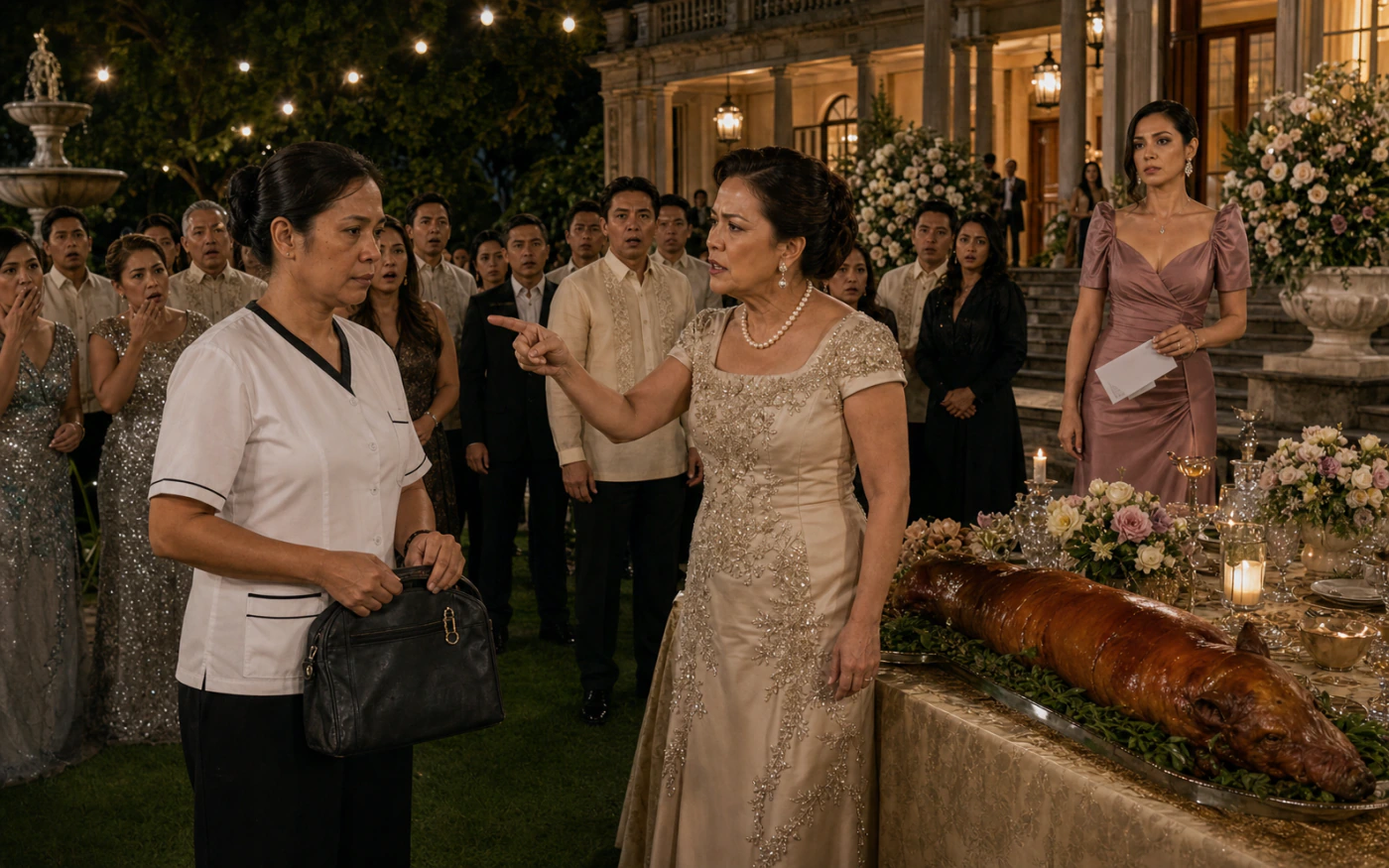
"Bring your bag."
Sir Boyet stepped forward. "Ma'am, ma'am, we can call the agency, they have a procedure—"
"Bring. Your. Bag."
I want to tell you what I felt and I am not sure I can, because the true answer is that I felt almost nothing.
You cannot be shocked twice by the same thing.
I went into the kitchen. I got my bag off the hook. It is a black bag with a broken zipper pull that I have replaced with a paper clip.
I came back out.
The señora pointed at the long table where the lechon had been, and forty people made a space around it, and my daughter was standing in that space, and she had not moved, and her glass was empty.
"Ilabas mo," the señora said. "Everything. On the table."
And here is the thing that has kept me awake since.
I did not have to.
I could have said no. I could have said call the barangay. I could have said one single sentence, one, that I have been carrying since 2011, and that garden would have come down like a wall.
I looked up.
The mayor was standing near the steps with her speech cards in her hand.
And she was looking at me.
Not at her mother. Not at the bracelet. At me.
I have known that girl since she was five years old and I know every face she has, and the one she had on was the one she used to make outside her father's study.
She was waiting to see what I would do.
So I did what I have done for fifteen years.
I opened the bag and I turned it over on the table myself.
PART 3: What the Mayor Knew
Here is what forty people watched come out of my bag.
A hairnet.
A folded plastic bag inside another plastic bag.
My reading glasses, one arm held on with tape.
Two blister packs of losartan and a half packet of Biogesic.
A small tin of Vicks.
My phone, which is not a smartphone.
And a coin purse, which came apart when it hit the table, and my bus fare went across that tablecloth and onto the grass, and three coins went under the table and nobody picked them up.
No bracelet.
Nobody said anything.
The señora looked at the table for perhaps two seconds, and then she said, "Well. Put it away," and turned to walk back toward her guests as though she had checked a delivery.
And my daughter said, "That is my mother."
She said it loudly.
She said it into that quiet, in that dress, in front of everyone she has been lying to for four years, and her voice broke on the second word and she said it anyway.
"That is my mother. Her name is Perlita Sadiwa."
The señora stopped.
And the mayor put her speech cards down on the step.
"Mama," she said.
Not to me. To the señora.
"Tell them why she left."
"Trisha—"
"No po." She came down onto the grass. She was crying and she did not wipe it and she kept her voice completely level, and I understood that she had rehearsed this, probably for years, probably many times, in a car.
She turned to the garden.
"In 2011 I was sixteen. There was a boy. He had photographs of me and he wanted forty thousand pesos and I did not have forty thousand pesos."
Somebody's plate went down on a table.
"So I took my mother's jewelry out of her drawer and I gave it to him."
"Trisha, that is enough—"
"Perla found out. She did not tell anyone." The mayor's voice did not move. "My mother called the police to the house. I was going to have to say it. In front of my father. In front of Father Emil."
"And Ate Perla said, I took it."
Forty people. Nobody moved at all.
"She said it twice. She said it until they believed her. And they fired her, and my mother made sure everyone in Malinao knew, and she has not worked in a house since."
She turned around and looked at her mother.
"You found out. Within the month. Papa told you and you did nothing, because it was cheaper."
"I did it to protect you—"
"You did it to protect the house."
The phones were up by then. Of course they were.
I did not say anything, because I still could not, because it is a habit now, because for fifteen years the whole shape of my life has been the not-saying.
Angel came and stood beside me and picked my glasses up off the tablecloth.
The bracelet was found at eleven o'clock in Mrs. Talens's own car, under the passenger seat, where she had put it.
She apologized to me in the driveway. She cried. I told her it was nothing po, because it was.
The mayor came to the house in Barangay Uno on a Sunday, two weeks after, with her husband and a box of ensaymada and no staff.
She sat in our sala, which is small, and she said sorry, and I let her say it all the way to the end without helping her, which I think is the only unkind thing I have ever done.
Then I made her coffee.
There is a letter now. On municipal paper, signed, saying what happened in 2011. Angel had it laminated, which I told her was too much.
Two houses have called me. I did not take either.
I am fifty-eight. I like the catering. You go, you work, you go home, and nobody watches your hands.
Angel moved back in last month. She says it is to save money.
She tells people her mother does catering.
She tells them in front of me, on purpose, a little too loud, and every single time she does it I have to go and check something in the kitchen.
Auntie Karma knows what honest hands carry. 💛