
The Boutique Manager Told Her to Shop "Somewhere in Her Budget" — Then the Old Seamstress Walked Out of the Back Room, Untying Her Apron...
PART 1: The Envelope
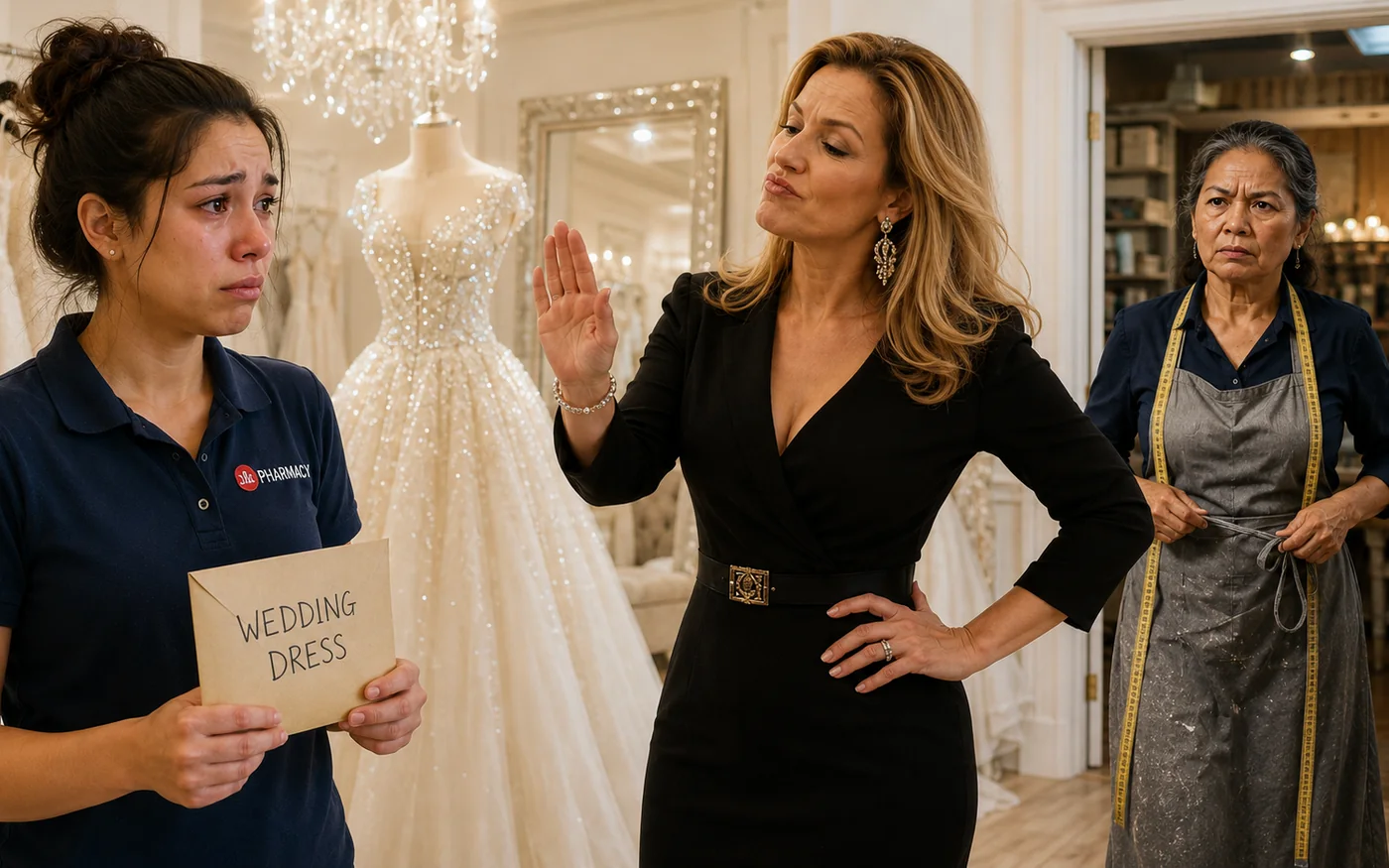
The boutique manager looked at my pharmacy uniform.
Then she looked at the envelope in my hand.
Then she looked at the door behind me.
“Our gowns begin at four thousand dollars,” she said.
Her name tag read BRITTANY — ASSISTANT DIRECTOR OF BRIDAL EXPERIENCE.
She smiled.
But only with her teeth.
“There’s a chain store near the highway that offers payment plans. You might feel more comfortable shopping somewhere in your budget, sweetie.”
She glanced at my surname on the sample-sale sign-in sheet.
“And with one of those big family weddings, you’ll have plenty of other expenses.”
I had not told her how many guests I was having.
“How many people do you think I invited?” I asked.
Her smile tightened.
“I only meant weddings are expensive.”
The two saleswomen behind the counter suddenly became fascinated by their fingernails.
A mother waiting near the mirrors lowered her eyes.
Her teenage daughter did not.
She stared at Brittany in disbelief.
My name is Grace Villanueva.
I worked six days a week at a neighborhood pharmacy, and I had saved for eleven months to buy one wedding dress.
Packed adobo and rice instead of takeout.
Extra Saturday shifts.
Walking home when the weather was good so I could save the bus fare.
Every five-dollar bill went into the same white envelope.
On the front, in my careful handwriting, were two words:
WEDDING DRESS.
Inside was eight hundred and forty dollars.
I knew it was not much in a boutique with gold letters on the window and champagne beside the fitting rooms.
But the sign outside said:
SAMPLE SALE — GOWNS FROM $500. WALK-INS WELCOME.
So I had come directly after work before somebody else bought the dress I could afford.
I had even called that morning.
“Come in,” a woman had told me. “A bride with a budget is still a bride.”
That woman had not been Brittany.
“I’m here for the sample sale,” I said.
“Yes. I heard you.”
She said it slowly.
As if my budget had also damaged my hearing.
“The inexpensive samples are mostly picked over,” she continued. “Missing beads. Damaged hems. I’d hate for you to be disappointed.”
“May I see them?”
Brittany sighed.
I had interrupted something important.
Possibly her standing there.
Behind her were six mannequins in white silk.
The one in the window wore the most beautiful dress I had ever seen.
From a distance, it was simple.
Ivory silk.
A clean neckline.
Long sleeves.
But hundreds of tiny sampaguita flowers had been embroidered along the bodice and cuffs.
Each petal was smaller than a grain of rice.
My mother had grown sampaguita in old coffee cans outside our apartment.
Every Sunday morning, she twisted the flowers into garlands before church.
She died four years before my wedding.
The dress made me remember her hands.
“What about that one?” I asked.
Brittany laughed.
Actually laughed.
“The Valencia?”
She glanced at the saleswomen.
One of them looked away.
“That is our showpiece. Hand-finished couture. It isn’t part of the sale, and it certainly isn’t for—”
She stopped.
Almost in time.
“For whom?” I asked.
“Walk-ins.”
Of course.
She meant women in pharmacy polos.
Women holding bus cards.
Women who saved five dollars at a time.
I heard my mother’s voice inside me.
You belong anywhere you enter with clean hands and a kind heart, anak.
But belonging does not mean begging people to see you.
I closed my envelope.
“Thank you for your time,” I said.
Brittany had already turned away.
I reached for the door.
Then a voice came from the back of the boutique.
“Put her in the Valencia.”
PART 2: When the Seamstress Removed Her Apron
An older Filipina woman stood in the workroom doorway.
She was small, with silver hair pinned at the nape of her neck.
A tape measure hung around her shoulders.
White tailor’s chalk covered her black apron.
I had noticed her when I arrived.
She had been struggling through the workroom door with a bolt of silk almost as tall as she was.
I held it open for her.
“Magandang hapon po,” I said.
She smiled.
“Good afternoon, anak.”
Then she disappeared into the back.
I assumed she was the alterations lady.
So did Brittany.
“Mrs. Esperanza,” Brittany said, forcing a laugh, “the Valencia is the showpiece. It’s not for sale.”
“I know.”
The old woman untied her apron.
“I made it.”
She hung the apron on a brass hook.
Brittany folded her arms.
“Of course you helped make it. But alterations doesn’t decide which customers wear couture.”
The old woman looked at her.
Not angrily.
Almost sadly.
“You’ve worked here six weeks, correct?”
“Seven.”
“And in seven weeks, did you ever ask my last name?”
Brittany’s smile vanished.
The old woman pointed toward the gold lettering on the window.
VALENCIA BRIDAL HOUSE.
Then she reached inside the nearest gown and turned out its silk label.
ESPERANZA VALENCIA — FOUNDER.
Nobody spoke.
The teenage girl near the mirrors slowly raised one hand over her mouth.
One of the saleswomen whispered, “Oh my God.”
Esperanza Valencia had opened the boutique forty years earlier with one borrowed sewing machine and a folding table.
Her first brides were nurses.
Teachers.
Hotel workers.
Immigrant women who arrived carrying their savings in envelopes exactly like mine.
She stitched their dresses at night after putting her children to bed.
One bride became ten.
Ten became a storefront.
The storefront became the elegant bridal house where Brittany now stood beneath Esperanza’s name.
Esperanza’s daughter managed the business.
But three days a week, its founder still sewed in the back room.
“The front is where dresses are sold,” she said. “The back is where they are made. I prefer the honest end.”
Then she looked at Brittany.
“It also lets me hear how people behave when they think nobody important is listening.”
Brittany went pale.
“Mrs. Valencia, I was only managing her expectations. She told me she had eight hundred dollars.”
“Eight hundred and forty,” Esperanza said.
She had heard everything.
“The sign promises samples from five hundred. Did you show her one?”
“The remaining dresses aren’t suitable.”
“For whom?”
Brittany glanced at my uniform.
Then at my surname on the sign-in sheet.
Only for a second.
It was enough.
Esperanza held out her hand to me.
“Come, anak.”
“Mrs. Valencia, I can’t afford that dress.”
“I didn’t ask what Brittany thinks you can afford.”
Her fingers closed gently around mine.
“I asked whether it fits.”
The fitting room was larger than my bedroom.
Esperanza helped me out of my blue pharmacy polo with the same care my mother once used with my Sunday dresses.
“Your hands are cold,” she said.
“I’m embarrassed.”
“No.”
She glanced toward the curtain.
“The embarrassed person is outside pretending to rearrange hangers.”
From the showroom came the frantic clatter of hangers.
I laughed despite myself.
Then Esperanza lowered the Valencia over my head.
The silk settled around me.
She pulled up the zipper.
When I opened my eyes, I saw my mother.
Not her face.
Her hands.
The flowers she grew in coffee cans.
The school uniforms she mended after midnight.
Every beautiful thing working women create while the world is busy looking past them.
“Sampaguita,” I whispered.
Esperanza met my eyes in the mirror.
“My mother’s favorite.”
“Mine too.”
She opened the curtain.
The mother near the mirrors began to cry.
Her daughter whispered, “That’s her dress.”
One saleswoman covered her mouth.
Even Brittany stared.
The Valencia fit as though it had been waiting for me.
Esperanza took the envelope from my hand.
She counted all eight hundred and forty dollars on the fitting-room table.
Then she pushed eight hundred back toward me.
I stared at the two twenties she kept.
“Forty dollars?”
PART 3: The Price Esperanza Chose
“I can’t accept this,” I said.
“You aren’t accepting anything. You are buying my dress.”
Esperanza held up the two twenties.
“Forty dollars was the price of the first wedding gown I ever sold.”
“That was forty years ago.”
“And it brought me forty years of luck.”
She folded my fingers around the rest of my money.
“Do not argue with successful mathematics, anak.”
The teenage girl laughed through her tears.
I did too.
Then Esperanza turned toward Brittany.
Every person in the boutique turned with her.
Brittany stood very straight.
“Am I fired?”
Esperanza considered the question.
“No.”
Relief flashed across Brittany’s face.
Too soon.
“On Monday, you begin one year in the workroom.”
“But I’m the assistant director of bridal experience.”
Esperanza looked at the gold name tag.
“Yes. That appears to be the problem.”
One saleswoman coughed into her hand.
Very badly disguised laughter escaped between her fingers.
“You will learn to measure,” Esperanza continued. “To pin. To cut. To remove every bead from a sleeve and sew it back without leaving a scar.”
Brittany swallowed.
“For a whole year?”
“Until you understand what four thousand dollars is actually made of.”
Esperanza did every fitting for my gown herself.
At the second fitting, she questioned my fiancé, Daniel, so thoroughly that he whispered afterward, “Was that a fitting or an immigration interview?”
“Both,” I told him. “You passed for now.”
At my final fitting, Brittany knelt to pin my hem.
The gold name tag was gone.
She wore a plain black apron.
Tiny needle marks dotted her fingers.
“Mrs. Valencia made me redo your left sleeve four times,” she said.
“Five,” Esperanza called from the worktable.
Brittany closed her eyes.
“Five times.”
Three weeks later, I walked down the aisle in the Valencia.
The sampaguita flowers caught the afternoon light.
My titas cried before the music even started.
Daniel cried when he saw me.
Then he denied it through most of the reception.
Esperanza sat in the second row wearing a cream hat.
Beside her was the empty chair I had reserved for my mother.
Before the ceremony, Esperanza placed a fresh sampaguita garland across its back.
She did not announce it.
She did not wait for anyone to thank her.
She simply understood.
The eight hundred dollars she returned to me paid for dinner, flowers and the little pharmacy-style paper bags of candy we gave our guests.
But the forty-dollar receipt is still inside my wedding album.
So is a photograph of me in the boutique window.
Esperanza framed it in gold.
Underneath, she placed a card in her own handwriting:
COUTURE: A dress made by hand for someone worthy of respect.
Years later, brides still stop to read it.
Some arrive in designer shoes.
Some arrive in work uniforms.
Esperanza greets every one of them the same way.
“Come in, anak.”
“A bride with a budget is still a bride.”
Auntie Karma never measures a bride by her budget. 💛