
My Fiancé’s Mother Poured Red Wine on My Mom’s Thrift-Store Gown — I Canceled More Than the Wedding...
PART 1: The Terno
The first thing I heard after the wine hit my mother's dress was laughter.
The second thing I heard was my fiancé.
Saying nothing at all.
My name is Marilag and I am a property lawyer in Batangas.
The Villaruels knew that. They simply decided it could not be very important.
To them, I was Rafael's quiet provincial fiancée. The woman who checked the caterer's contract. Chased the florist. Fixed every little wedding problem before Doña Esperanza noticed it.
They treated me like unpaid help with an engagement ring.
For two years, I let them underestimate me.
It was easier that way.
You learn a lot about people when they decide you are beneath them.
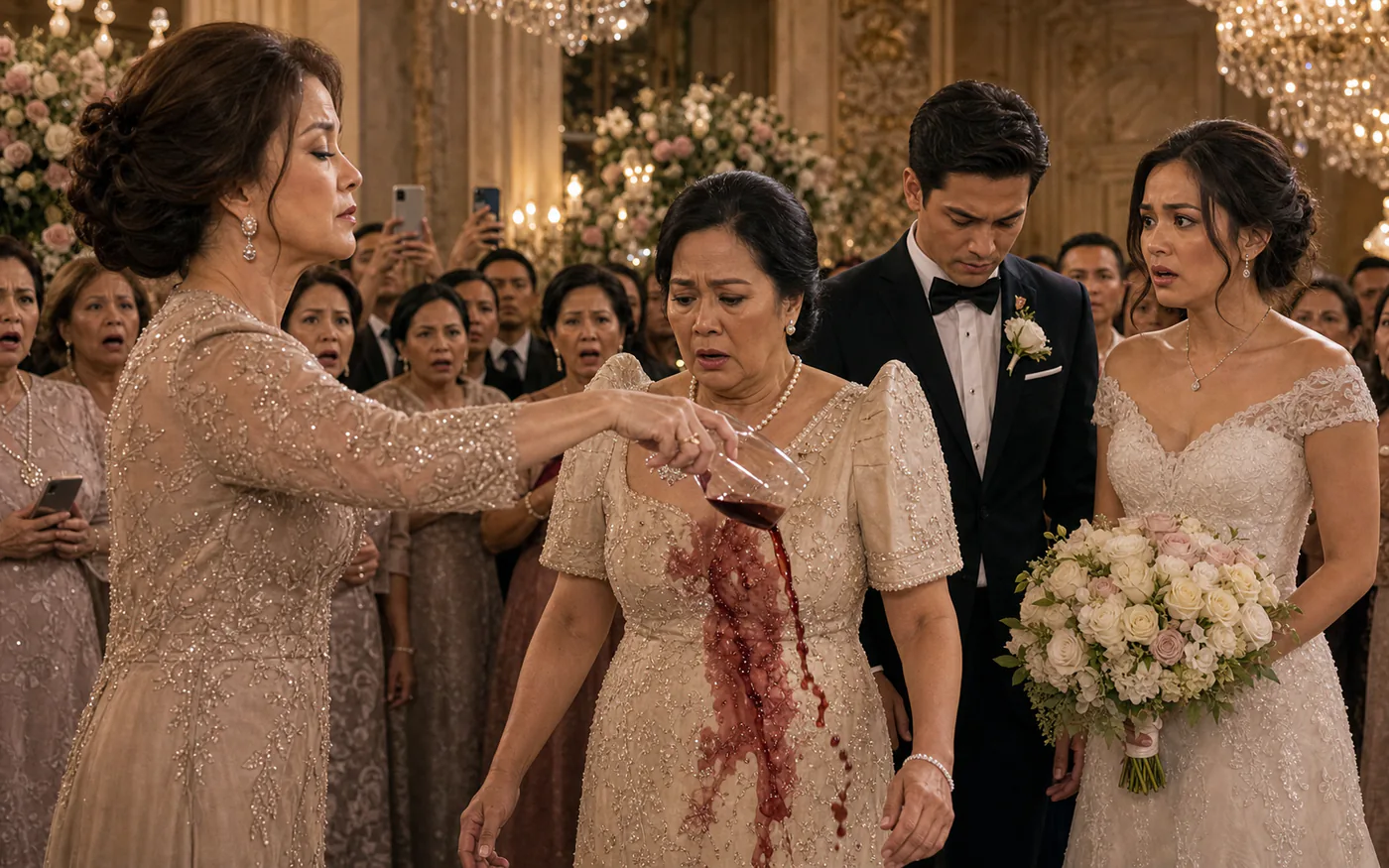
The red wine spread across my mother's terno like a wound.
She had saved four months for that gown.
An ukay-ukay find. Re-beaded by hand, at the kitchen table in the province. Humming while she did it.
Now she stood very still in the middle of the Marbella's grand ballroom.
Four hundred of Manila's finest turned to look.
"Naku, how clumsy of me," said Doña Esperanza.
She had not been clumsy once in sixty years.
She set down the glass. She wrinkled her nose.
"But you know — that is the closest your family will ever come to owning something expensive."
"Red wine. On a borrowed dress."
Then she turned to the crowd.
"Let them enjoy it."
Phones lifted. A few titas gasped.
More of them filmed.
I turned to Rafael.
The man I was supposed to marry in one hour.
He was staring at his shoes.
"Say something," I said quietly.
"Marilag." His jaw tightened. "Mama has had a little wine. Please. Not tonight. Once we're married, things will be different, I promise—"
He had been promising me that for two years.
He promised it when the Doña called my father "the sari-sari store man."
He promised it when she asked my mother, loudly, if she knew which fork to use.
Always in private. Always afterward.
Always with a promise. Never with a spine.
My mother reached for my hand. "It's alright, anak," she whispered, dripping. "Let's just go home."
"No, Ma," I said. "It really isn't alright."
"And we're not the ones who are leaving."
I set down my bouquet.
I walked to the bandstand.
I picked up the microphone.
The quartet stopped mid-song.
"Good evening," I said. "Thank you all for coming."
"The wedding is canceled."
A murmur rolled through four hundred people.
"And please — enjoy the Marbella tonight. Take photos. Stay late."
"Because in nine days, the Villaruel family will no longer control the ground beneath it."
Doña Esperanza laughed again. Shorter, this time.
"You?" she said. "Anak, you spent six months arranging flowers."
That was all she thought I was good for.
I reached into the little beaded purse everyone assumed held lip gloss.
And I took out my phone.
PART 2: What I Did Next
Here is the thing about the Marbella Hotel.
The crown of the Villaruel empire. The address on all of Doña Esperanza's stationery.
It does not sit on Villaruel land.
It sits on four thousand square meters my grandparents bought in 1961.
Lola Consolacion.
They paid for it with the money my Lolo made driving a jeepney. Sixteen hours a day. One peso at a time.
After he died, the title remained in my Lola's name.
In 1986, a young and charming Don Villaruel came to my Lola with a lease.
Forty years. A gentleman's rate. Terms his family would one day wish they had read more carefully.
But my Lola insisted on putting every promise in writing.
There would be no automatic renewal.
And when the lease ended, the permanent improvements on the land would revert to her unless both families signed a new agreement.
He built his hotel on our ground.
And told everyone he built an empire.
He died. His widow did not forget the lease.
She forgot who had given them the ground — and began treating renewal as her birthright.
Rich people have the luxury of forgetting where the ground comes from.
I did not forget.
The lease carried my Lola's full name. I carry my father's surname.
Rafael knew her only as Lola Conching, the tiny woman who waved during our family video calls. Neither he nor his mother had ever bothered to ask her full name.
I have handled my Lola's property affairs since I passed the bar.
The reason I volunteered to handle every venue contract for this wedding?
The reason I asked so many questions about the Marbella's finances while Rafael complained that lawyers can never relax?
It was not devotion. It was diligence.
Because the lease on the ground beneath your feet expires in nine days.
My Lola served the required written notice last year. Since then, the Villaruels had been negotiating as if renewal were guaranteed.
For two years, I had been advising her — slowly, the way my mother re-beads a gown — whether your family deserved a new lease.
This morning, Lola signed a special power of attorney authorizing me to make the final decision.
Tonight you answered that for me.
"Attorney Salazar," I said into the phone. He was the managing partner at my firm, and he had been waiting for my decision.
I held the phone near the microphone so all four hundred guests could hear every word.
"Yes. I'm at the Marbella."
"End the renewal negotiations tonight. Send the final confirmation that our notice remains in force."
"I have Lola Consolacion's notarized special power of attorney in my purse."
"Accept the Ramirez Group's ground-lease proposal."
"Yes. The one they've chased for six years."
"Tell them they take possession on the first of the month, under the reversion clause."
I looked up.
Rafael had gone the color of my mother's spilled wine.
White, with red spreading through it.
Because Rafael, unlike his mother, had read the refinancing agreement.
He knew the bank would extend the Villaruel loans only if the ground lease was renewed.
Without a new lease, the Marbella would lose the right to operate at its address, its future income, and every permanent improvement his grandfather had agreed would revert to my Lola.
In nine days, the Villaruel name would come off the hotel.
"Marilag," he whispered.
"What did you do."
PART 3: The Phones Turned
"Nothing," I said. "That's the beautiful part."
"I didn't take anything from you."
"I simply stopped lending it."
Doña Esperanza's smile came apart slowly.
The way expensive things do. Not all at once. Thread by thread.
"You wouldn't dare," she said. "Do you know who we are?"
"Do you know what this hotel is worth?"
"To the peso," I said.
"And I know it's worth nothing without the four thousand square meters my Lolo bought with a jeepney and a thermos of rice."
"You have stood on my family's ground for forty years, Doña. Calling us poor."
"Tonight you poured wine on the daughter of the woman who owns the floor of your ballroom."
The room went so quiet I could hear the ice melting in four hundred glasses.
And then — I will remember this until I die — the phones began to turn.
Slowly. The way a field of sunflowers turns.
Away from my dripping mother.
Toward the Doña.
The same guests. The same cameras. Pointed now at the face of a woman watching control of her empire transfer in real time.
She understood it then.
Not the money — she'd understood the money the moment I said Ramirez.
She understood the shame.
That every person she had ever made small was watching. And filming. And would still be watching tomorrow.
"Marilag — anak—" She reached for me with a hand full of diamonds. "Surely we can discuss this. Family to family."
I thought about my mother.
Re-beading a two-hundred-peso gown at a kitchen table. Humming. Excited to meet her daughter's new family.
And I took the Doña's own words, still warm in the air, and handed them back.
"I'm afraid not, Doña. But you know—"
I looked at the wine. At the ballroom. At the ground.
"That forty-year lease was the closest your family ever came to owning something expensive. And it was always borrowed."
Here is the ending. I tell it with my shoes off, at my mother's kitchen table in the province.
I did not marry Rafael.
A man who studies his shoes at thirty-five will be studying them at seventy.
The Ramirez Group renovated the Marbella. They kept most of its workers, and they pay my Lola an honest ground rent now.
Part of that rent funds a scholarship for jeepney drivers' children.
Because my Lola remembers exactly where the ground came from.
And my mother still wears the wine-stained terno sometimes. To the market. On purpose.
When anyone asks why she doesn't just buy a new one, she smiles.
"It is the most expensive dress I own," she says.
"It cost the Villaruels everything."
Auntie Karma never forgets where the ground came from. 💛