
At Mama's Wake, My Sister Laughed, "You Get Whatever Is in the Basement." I Went Down the Eleven Steps. Then I Heard the Bolt Slide.
PART 1: Mama's Flashlight
The first thing I heard after my sister finished reading the will was laughter.
The second thing I heard was the bolt.
Three years before Mama's wake, I gave up a nursing contract in Dubai and came home to take care of my mother.
Charmaine did not.
Charmaine came twice.
Once at Christmas, for two hours, in white pants.
And once at the end, when the doctor said days instead of weeks, and she arrived with a lawyer.
The wake was at the house, the way Mama wanted. Nine nights. White curtains. Sampaguita everywhere, sweet enough to make your head ache.
Half the barangay came. Mama fed all of them for thirty years from her little carinderia at the corner, so all of them came.
On the sixth night, Charmaine had the will read in the sala.
In front of everyone.
She did not have to do it that way.
She wanted to do it that way.
Atty. Mendoza was uncomfortable. I could see it. He kept looking at the door.
"The house and lot in Barangay San Roque," he read. "To Charmaine Ocampo Villamor."
Charmaine's husband squeezed her shoulder.
"The savings account at the rural bank. To Charmaine Ocampo Villamor."
Somebody's spoon clinked.
"The carinderia and its equipment. To Charmaine Ocampo Villamor."
I looked at the floor.
Not because I was surprised.
Because forty relatives were watching my face, and I did not want to give them anything.
"And to my daughter Divina Ocampo," Atty. Mendoza read, "I leave the contents of the basement."
The room went quiet for exactly one second.
Then Tita Nora laughed.
And once one person laughs, everyone is allowed to.
Because everybody in that house knew what was in our basement.
Broken electric fans. A dead refrigerator. My father's tricycle sidecar, rusted through, from 1998. Nine years of my mother's newspapers, tied with string.
Junk.
The room where you put the things you cannot throw away and cannot use.
"You get whatever is in the basement," Charmaine said. "Congratulations, Ate. You got the rats."
She said Ate like a joke. Like it was funny that I was older.
Her husband laughed the loudest.
"Well," Charmaine said, standing, smoothing her dress. "Maybe you should go and check your inheritance."
More laughter.
"Go on. Check it. Make sure nobody stole your newspapers."
And here is the part I want you to understand.
I went.
Not because she told me to.
Because I could not sit in that sala one more minute with those faces.
And because those were Mama's things.
Nobody else in that house had ever gone down there. Nobody else had ever wanted to.
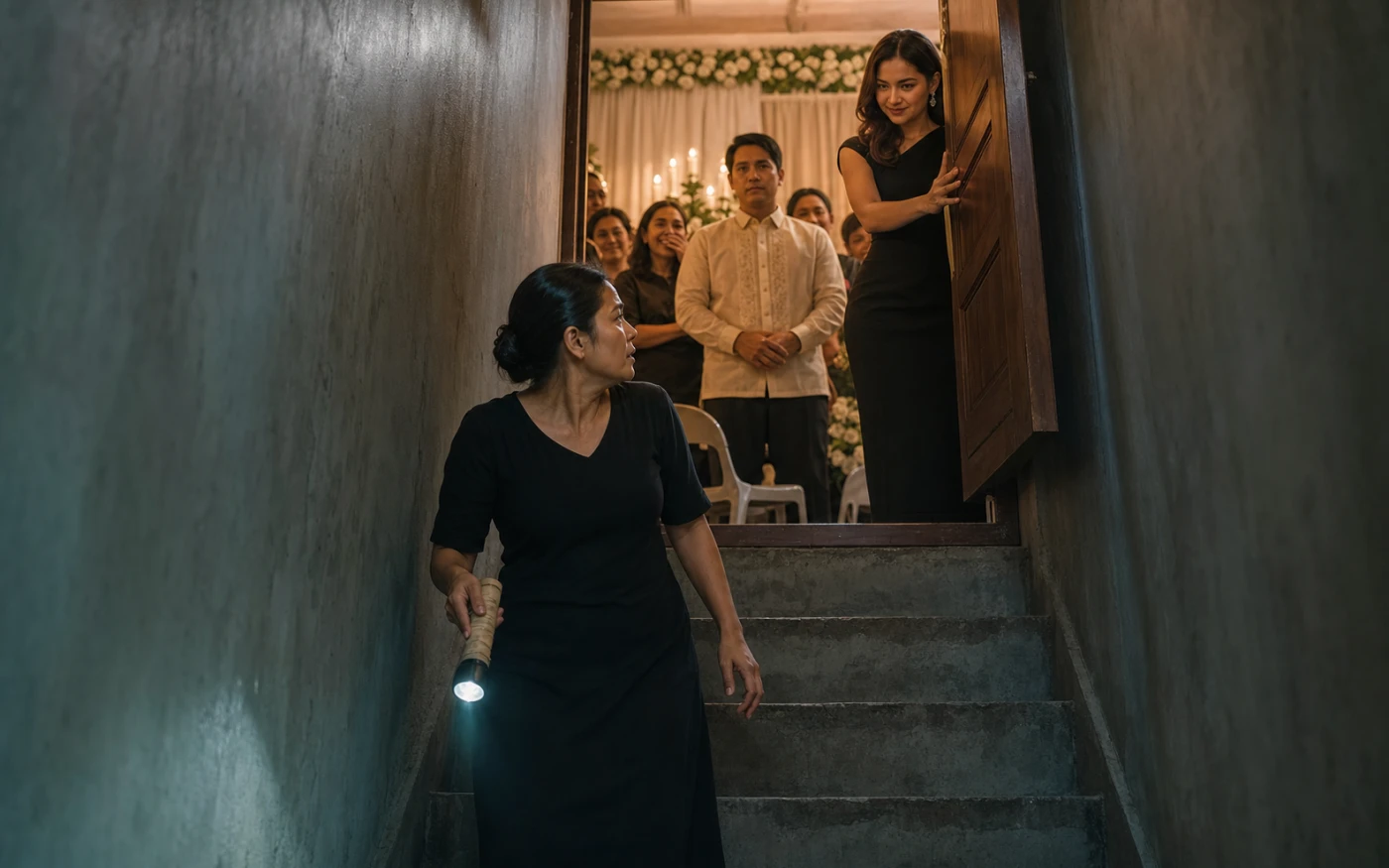
I took the flashlight from the kitchen drawer. The one Mama kept for brownouts. It still had her masking tape on the handle with her name on it, in her handwriting, because she lent it out and people are people.
I went down the eleven steps.
I was three steps down when I heard her heels on the tile above me.
"Enjoy your inheritance, Ate."
The door swung shut.
And then, in a house with sixty guests and a coffin in the sala, my sister slid the bolt across.
I stood there in the dark and listened.
I heard her tell the room the lechon was ready.
I heard them go.
PART 2: What I Found Down There
I did not cry.
I want to say that I did, because that is what you would expect.
But I had done all my crying in a hospital corridor in March, and there was none left.
So I turned on Mama's flashlight and I looked at Mama's things.
The tricycle sidecar was still there. Papa died in 1999 and Mama never let anyone take it.
Her sewing machine.
Nine years of newspapers, tied with string, because she saved every issue that had a photograph of somebody from our barangay in it.
I sat down on the bottom step and I went through all of it.
Slowly.
The way you do when it is your mother.
I found her rosary in a coffee jar.
I found my elementary report cards. All of them. Mine and Charmaine's, in separate rubber bands.
I found the receipt for my nursing school tuition, 13 pages, folded and refolded until it was soft as cloth.
She kept the receipt.
Twenty-two years, she kept the receipt.
It took me almost two hours to reach the back wall.
And the back wall was wrong.
I want to be clear that I am not clever. I am a nurse. I have never solved a mystery in my life.
But I grew up in that house.
And the back of our basement used to have a window.
A small one. High up. Frosted glass with chicken wire in it. I know it was there because I used to watch Mama's feet go past it when she hung laundry.
Now there was a wall where the back of the room should have been.
New cement. Not new like this year. New like maybe ten years ago. Smooth, and flat, and completely wrong against three hundred kilos of 1970s hollow block.
And in front of it, pushed flat against it, was Mama's old aparador. The big wooden one from her own mother.
I pushed it.
It did not move.
I emptied it first. Coats. A wedding dress in plastic. My father's barong.
Then I pushed it again and it slid, screaming, across the concrete.
Behind it was a door.
Not a secret door. Nothing dramatic. Just a plain wooden door, painted the same green as the rest of the basement, with a padlock on it.
And taped to the padlock, in a plastic sandwich bag, was a key.
My mother had left the key taped to the lock.
Because she knew.
She knew that whoever found this door would be the person who had bothered to move the aparador. And the only person who would ever bother to move the aparador was the person who had come down here to look at her things.
Not for the things.
For her.
I opened it.
It was a small room. Maybe two meters by three. The old window was still there in the original outside wall, hidden from the yard behind decorative concrete blocks, and the frosted glass was letting in a little gray light.
It was clean.
That is the thing I remember. It was swept.
There was a folding table in the middle.
On the table there were three biscuit tins.
The first one had gold in it.
Not treasure-chest gold. Auntie gold. Chains and bangles and little pendants, thirty or forty pieces, each one in its own tiny plastic bag with a date written on the outside in pencil.
Every good year of the carinderia, my mother had walked to the pawnshop and bought a little gold.
For thirty-two years.
The second tin had American dollars in it. Bundled with rubber bands that had gone to powder.
The third tin had papers.
A land title. Two hundred and forty square meters on the highway, in my name, transferred in 2019.
And an envelope.
Para kay Divina.
PART 3: What Mama Wrote to Me
I read the letter sitting on the floor of a room my mother built to hide things from her own daughter.
Not from me.
I am going to tell you the part that matters.
She wrote: If you are reading this, then your sister already took the house, and you already went down to look at my things anyway.
Anak, I am sorry for the joke. It was the only way I could think of to give it to the right one.
Your sister would never have gone down the stairs.
She wrote about the gold. Which pawnshop. What the pieces were worth. She had it all written down in her carinderia notebook handwriting, the same handwriting she used for utang, neat and small and slightly crooked.
She wrote: Do not fight with your sister. It is not worth your peace. Let her have the house. I have already given you more than the house.
And at the bottom:
Ang singsing ay sa iyo. Huwag mong ibenta.
The ring is yours. Do not sell it.
The ring was in the envelope, in a twist of tissue paper.
My father's ring. The one Mama wore every day of my life until the morning she went into the hospital, when she told me she had put it somewhere safe.
The one Charmaine called Mama's glass ring in front of company.
The one my sister asked for twice while Mama was still breathing.
At six-thirty in the morning, the bolt slid back.
Charmaine opened the door with her phone already up, ready to film me crying in the dark, and I want you to know that I have thought about her face every day since.
Because I was standing at the top of the stairs.
Waiting.
Holding a biscuit tin.
"Ate," she said. "You're being dramatic."
Behind her, in the sala, the seven o'clock people were arriving with pandesal.
Atty. Mendoza was already there, because I had called him at four in the morning, and he had come at six, and he had been drinking coffee in the kitchen for half an hour with a very strange expression.
"Attorney," Charmaine said, brightening. "Perfect. Ate, before anything, please sign the settlement. It is only a formality. You accept Mama's will exactly as written and waive any further claim against me. I signed it yesterday."
She had brought a settlement agreement to a wake.
Her signature was already at the bottom.
"Give me the pen," I said.
I signed it on the top of the washing machine.
I used her pen.
Then I put the biscuit tin on the dining table, in front of forty people eating pandesal, and I opened it.
And I let them look.
Nobody said anything for a long time.
Somebody's phone went off and they shut it off fast.
"That is Mama's," Charmaine said.
"Yes," I said.
"That belongs to the estate."
"Attorney?" I said.
Atty. Mendoza put down his coffee.
"The contents of the basement," he said, "are Miss Divina's. Specifically and by name." He looked at the settlement on the table. "And this agreement is now fully executed. Each sister has accepted the will exactly as written and waived the right to contest the other's bequest."
I would not call what happened next dignified.
She said the room did not count as the basement.
She said the door was a separate room.
She said, and I am quoting her, "There was a window, that is a ground floor."
She said it to a lawyer, in front of forty people, over her mother's coffin.
The phones came up.
Not at me this time.
The house is still hers. I never contested it. Mama told me not to and I do what my mother says.
She lives there. It is a nice house. She rents out the carinderia to a man who sells cell phone loads now, which I try not to have feelings about.
I bought the lot on the highway back from nobody, because it was already mine, and I opened a small canteen on it. Twelve tables. I called it Saring's, because that was what everyone called my mother.
I hired two of the ladies who used to help her.
We open at five for the tricycle drivers.
The gold paid for all of it and there is still most of it left, in a bank now, in the boring way you are supposed to.
A man from Manila came last year and offered me one hundred and eighty thousand pesos for the ring.
He explained, very slowly, the way people explain things to women who work in canteens, that the stone was old-cut and that I probably did not realize what I had.
I told him I realized.
Everyone in our barangay used to say Mama's ring was glass.
Because Papa drove a tricycle, and men who drive tricycles do not buy real ones.
It was not glass.
Neither was she.
Auntie Karma always goes down the stairs. 💛