
For Thirty Years I Fed Broke Students on Credit. The Day I Was Evicted from My Carinderia, a Black Car Stopped Outside and a Man Asked, “Do You Still Have the Notebook?”
PART 1: Forty-Two Pesos Left
The eviction letter said I had thirty days to leave.
There were exactly forty-two pesos in my cash drawer.
I counted both twice.
Then I turned the rice cooker back on, because the lunch crowd comes at eleven whether or not your whole life has just been sold to a coffee franchise.
At sixty-three, I had spent thirty years running a carinderia on a Quezon City corner that smelled like diesel, garlic, and rain.
Six plastic tables.
One tired electric fan.
A chalkboard menu that changed according to whatever was cheap at the palengke.
My late husband, Tony, and I opened it with a borrowed stove and one rule:
Nobody hungry leaves because they are short on money.
“Isulat mo sa notebook,” Tony would say. “Pay when life becomes kinder.”
We kept the notebook beside the soy sauce.
If a student had only enough money for jeepney fare, I wrote down twelve pesos.
If a nursing intern had not received her allowance, I wrote down twenty.
If someone asked for extra rice and looked ashamed, I pretended I had forgotten to write anything.
By the time Tony died, there were three notebooks held together with rubber bands.
Hundreds of names.
Thousands of meals.
Almost none of them paid.
That never bothered me.
Hungry students disappeared into graduation gowns. That was the point.
The young man who delivered my eviction notice stood awkwardly beside table two.
“Aling Nena, the building changed owners,” he said. “The new monthly rent is thirty thousand pesos.”
I laughed.
In thirty years, that little corner had never earned thirty thousand pesos in one month.
“What will they put here?”
He looked at his clipboard.
“A specialty coffee shop.”
“How much is the coffee?”
“Maybe two hundred eighty pesos.”
“Does it come with lunch?”
He almost smiled.
“I’m sorry, po. They want the unit empty in thirty days.”
His name tag said Nico. He looked pale and too thin inside his office shirt.
“Sit down,” I told him.
“I can’t.”
“You came all this way to destroy an old woman. At least eat first.”
I gave him chicken adobo, rice, and the last fried egg.
He ate every grain.
When he asked how much, I waved him away.
“Some meals are just a gift.”
Mang Berto, the jeepney driver who had eaten at table two since 1998, heard everything from behind his newspaper.
“How much do you need?” he asked.
“There is no amount. A coffee franchise and an old woman are not a fair fight.”
Mang Berto took out his phone and began typing with one thick finger.
“What are you doing?”
“Nothing.”
“You type very loudly for nothing.”
He took a photograph of the eviction letter before I could stop him.
That night, his post said:
THE WOMAN WHO NEVER LET OUR CHILDREN GO HUNGRY HAS THIRTY DAYS LEFT.
By morning, it had been shared seventeen times.
By the next week, it had been shared eighteen thousand.
Strangers began arriving.
Some bought lunch.
Some left extra money.
One woman pushed five thousand pesos into my hand and ran before I could return it.
But thirty thousand pesos every month was not a rent. It was a slow execution.
I used the donations to pay my two helpers and buy enough food to finish the month.
Then a college boy named Paulo came in with thirty pesos and ordered the cheapest meal.
He counted his coins three times.
“Keep your fare,” I said.
“But you are closing.”
“Hunger does not become polite because I have an eviction notice.”
I opened a fourth notebook and wrote his name on the first page.
On my final Friday, I cooked every dish Tony loved.
Adobo.
Giniling.
Pancit.
Enough rice for fifty people, although I expected twelve.
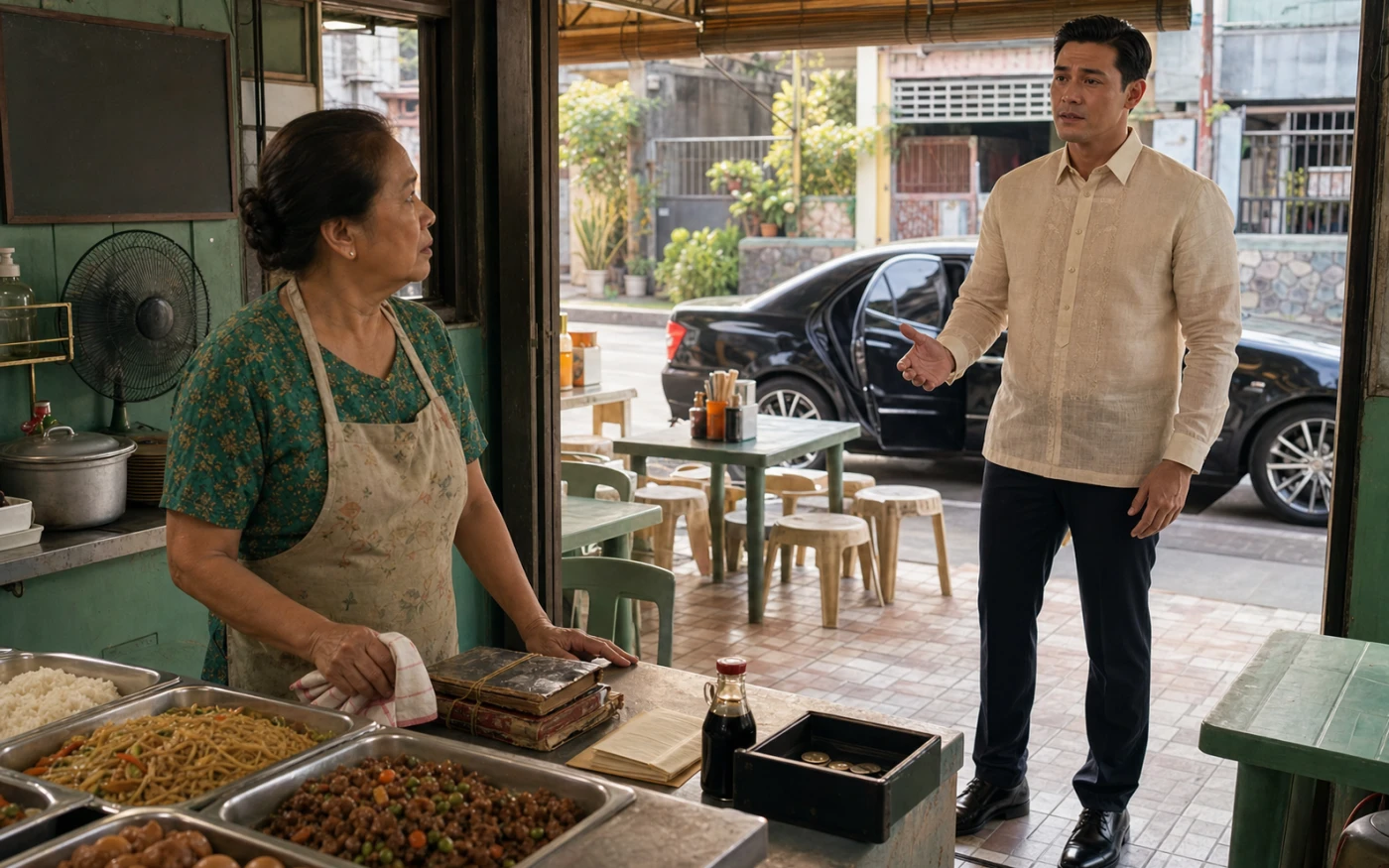
At ten thirty, a black car stopped outside.
A tall man in a pressed barong stepped out.
He entered slowly, stared at table five, and touched the old knife marks along its edge.
Then he looked at me with tears in his eyes.
“Aling Nena,” he said, “do you still have the notebook?”
PART 2: Names From the Notebook
“Which notebook?” I asked.
His laugh broke in the middle.
“The first one. Emil Navarro. Chicken adobo, extra rice, and the fried egg you always claimed you did not have.”
I looked at his polished shoes.
Then I saw the skinny scholarship boy from Samar who had studied at table five until I turned off the lights.
“Emil?”
He smiled.
“You got so tall,” I whispered.
“You fed me.”
From 2009 to 2013, Emil ate at my carinderia four days a week.
His boarding room had no refrigerator and sometimes no electricity. He studied engineering under my fluorescent light while Tony complained that the boy would ruin his eyes.
On graduation day, Emil promised he would return after his first salary.
He never did.
“I was ashamed,” he told me. “First I had no money. Then I had money but had waited too long. Every year, coming back felt harder.”
“Anak, it was adobo, not a bank robbery.”
The door opened behind him.
A woman in blue hospital scrubs walked in.
“Leah Mendoza,” she said. “Notebook two. I always asked for extra sabaw.”
Behind her came a public-school teacher still carrying chalk.
Then an architect.
Then two nurses home from Dubai.
Then a barangay captain who pointed at table three and shouted, “That was my seat!”
The six tables filled.
People stood along the walls.
More gathered on the sidewalk.
Every few seconds, someone called my name.
“Aling Nena, remember me?”
“You fed me during board exams.”
“You packed dinner for my little sister.”
“You let me wash plates when I was too proud to take credit.”
I held the counter because the room had begun to move.
Mang Berto stood outside grinning like a criminal.
“You did this,” I accused.
“I only made one post.”
Emil raised his voice.
“Three hundred twelve former students answered that post.”
The carinderia went quiet.
He set a folder on table one.
“Some sent two hundred pesos. Some sent two hundred thousand. One sent an apology written on hotel stationery because she is working on a ship and could not come home.”
He opened the folder.
Inside were bank records, letters, old school photographs, and copies of notebook pages people had kept on their phones for years.
“We calculated everything we owed,” Emil said.
“You cannot calculate it. Sometimes I added extra rice.”
“We noticed.”
Everyone laughed.
Then Nico, the young man who had delivered my eviction notice, appeared in the doorway.
Behind him stood a severe woman in a cream suit.
“Aling Nena,” he said nervously, “this is Ms. Clara Valmonte, the building owner.”
Clara looked at the crowd blocking the sidewalk.
“Your deadline is today,” she said. “The coffee company’s contractor arrives Monday.”
Emil stepped forward.
“We submitted an offer to purchase the building.”
Clara’s expression did not change.
“The franchise offered more.”
“Your office told us their agreement was not yet final.”
She looked sharply at Nico.
He straightened.
“It wasn’t, ma’am.”
Clara turned back to me.
“This public campaign is emotional pressure.”
“I did not ask anyone to come,” I said.
“But they came,” Emil replied.
He placed the three notebooks beside his offer.
Clara picked up the first one.
Names filled every page in my handwriting.
Beside some, Tony had drawn a line after they graduated.
Beside others, I had written:
Passed nursing board.
Found work.
Mother is sick. Do not ask yet.
Clara stopped at one name.
ARTURO VALMONTE.
She looked at me.
“That was my father.”
I remembered him then.
A young accounting clerk who ate rice and broth for six months after sending his salary home to his children.
“He always saved the meat for his daughter,” I said.
Clara’s fingers tightened around the notebook.
“My father bought this building ten years later.”
“He gave me low rent because he remembered being hungry.”
She closed the book.
For a long moment, nobody spoke.
Then she looked at Emil.
“Can your group transfer the full amount today?”
“Within the hour.”
Clara took a pen from Nico.
She signed the offer on table five.
I thought that was the miracle.
Then Emil slid the completed contract toward me.
At the top were the words TABLE FIVE COMMUNITY COOPERATIVE.
“We bought the building,” he said.
I pushed the folder back.
“No. I cannot accept a gift this large.”
Emil smiled.
“Good. Because it is not a gift.”
PART 3: Paid With Interest
Emil turned the contract around.
The cooperative had three hundred twelve members.
The ground floor would remain affordable space for neighborhood businesses. The upper rooms would become study rooms and small offices rented at normal rates.
My carinderia would stay exactly where it was.
“Your rent is forty-two pesos a month,” Emil said.
“That is ridiculous.”
“That is what Mang Berto said you had in the drawer.”
“The electricity costs more.”
“Then stop leaving the fan on when no one is here.”
I hit his arm with a dish towel.
The whole room cheered.
Emil became serious.
“You never called those meals charity. You called them credit because you protected our dignity.”
Leah, the doctor in scrubs, took my hand.
“This is not charity either. It is repayment.”
“With too much interest,” I said.
“You fed us when every adult calculation said you could not afford it,” she replied. “Do not complain because we learned your mathematics.”
Clara Valmonte watched from the doorway.
Before she left, she placed the first notebook in my hands.
“My father never told us he had gone hungry.”
“Hungry children become very good at hiding it.”
“Thank you for seeing him.”
She reduced the final sale price by the amount her father had once written beside his name.
Eighteen pesos.
It was not financially important.
That was why it mattered.
We reopened the following Monday.
Nobody replaced my six tables.
Nobody painted the walls minimalist gray.
The cooperative repaired the leaking roof, rewired the kitchen, and installed a fan powerful enough to move actual air.
They framed the first three notebooks behind the counter.
Underneath, Emil placed a small sign:
PAID IN FULL, WITH INTEREST.
The fourth notebook stayed beside the soy sauce.
The boy named Paulo returned after class and stared at the framed ones.
“Are those people famous?”
“Some of them.”
“Did they really owe you money?”
“They owed me lunch.”
He looked worried.
“Will my name be framed someday?”
“Only if you become too important to visit.”
He promised he would not.
Children always promise.
Sometimes they come back in black cars.
The carinderia became busier, but I refused to make it fancy.
The menu still depended on the palengke.
The glasses still did not match.
Mang Berto still occupied table two and denied starting everything.
Nico came every payday. He always paid double until I threatened to write his name in the notebook for wasting money.
Clara came once a month and ordered the rice and broth her father used to eat. The first time, she cried quietly into the bowl.
And Emil came every Sunday.
He always ordered chicken adobo, extra rice, and a fried egg.
Every Sunday, I told him there were no eggs.
Every Sunday, I somehow found one.
On the first anniversary of the eviction letter, the cooperative held a lunch.
All three hundred twelve members could not fit, of course. They came in shifts.
A teacher wrote the old rule on the chalkboard:
PAY WHEN LIFE BECOMES KINDER.
Emil asked whether life had finally become kind to me.
I looked around at the six crowded tables.
At adults who had once eaten with their school bags clutched against their stomachs.
At their children sharing rice.
At a new student quietly opening the fourth notebook.
“Life was kind before,” I told him. “It just took a long time to pay.”
I still keep the eviction letter beneath the cash drawer.
On difficult mornings, I count the forty-two pesos beside it.
Not because I am afraid of losing the carinderia.
Because I want to remember how close I came to believing that thirty years of kindness had disappeared into nothing.
It had not disappeared.
It had become engineers, nurses, teachers, drivers, and parents.
It had been walking around the world under different names.
And when I needed it, it remembered the way home.
Auntie Karma knows that kindness written in an old notebook can return with more interest than any bank could afford. 💛