
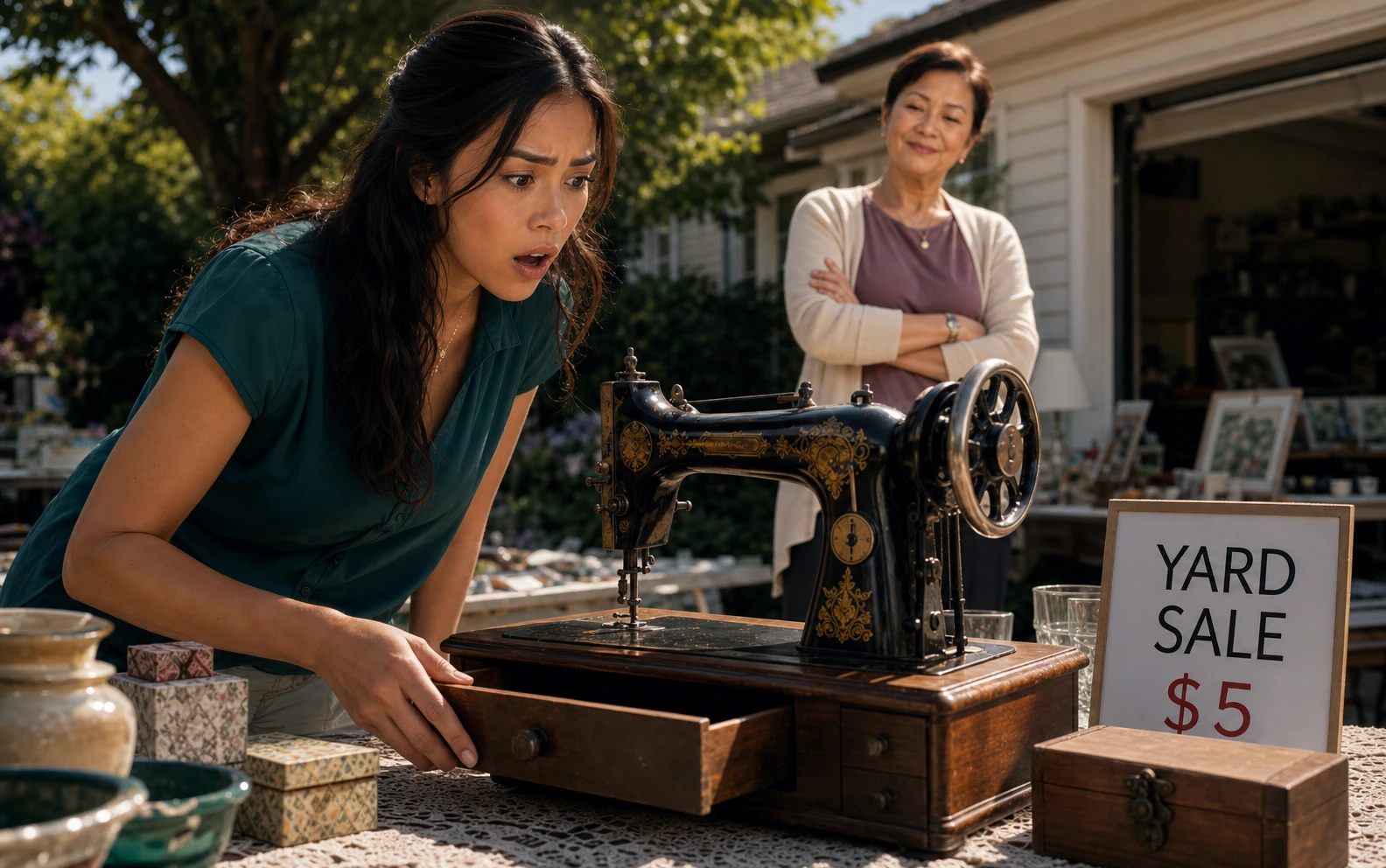
My Stepmother Sold My Late Mother's Sewing Machine at a Yard Sale for Five Dollars — An Hour Later, the Buyer Came Back Shaking...
PART 1: The Yard Sale
My mother's sewing machine sat in the corner of our living room my entire childhood, humming like a small patient animal.
On that machine, Nanay made my school uniforms. My sister's graduation dress. The curtains for every window in the house.
When money was thin — and money was always thin — she took in alterations after her shift, and the machine hummed past midnight.
"This machine put rice on the table," she used to say, patting it like a coworker. "Be respectful."
I'm Angela. I teach third grade, two towns away from the house I grew up in.
Nanay passed when I was twenty-three.
My father remarried within the year.
Lorraine arrived with matching luggage and opinions about everything.
Lorraine called our house "dated."
Lorraine called my mother's things "clutter."
Lorraine had a way of redecorating grief right out of a room.
Then, one Saturday morning, my sister called me, crying so hard I couldn't understand her at first.
Lorraine was holding a yard sale.
"Clearing the clutter," she'd announced.
And on a folding table in the driveway, between old paperbacks and a broken toaster, sat our mother's sewing machine.
Price tag: five dollars.
I drove ninety minutes with my heart in my throat.
I was too late.
"Some woman bought it," Lorraine said, not looking up from her cash box. "Five dollars. Honestly, I'd have paid her to haul it away."
She smiled at me.
"It was an eyesore, sweetie. You'll thank me."
I stood in the driveway where the machine had been, and I could not speak.
My sister squeezed my hand.
My father looked at his shoes, the way he had learned to.
And Lorraine went back to counting singles, satisfied. A woman at peace with a job well done.
That is when the car came back.
It pulled up fast and parked crooked, and a woman about my mother's age got out.
The buyer.
She was holding the sewing machine's little maintenance drawer in both hands, like it was made of glass.
And she was shaking.
She looked at Lorraine. Then at me. Then back at Lorraine.
"Who owned this machine?"
Her voice was very careful.
"I need to know. Who exactly owned this machine?"
PART 2: What Was In The Drawer
Lorraine perked up instantly.
She could smell money through drywall.
"Why? Is it valuable? Because technically, the sale was—"
"Not the machine," the woman said.
She set the drawer down on the folding table, in the exact spot where the machine had been sold.
And she lifted out the false bottom.
The false bottom my mother had fitted into it.
The false bottom none of us — not me, not my sister, not my father — ever knew was there.
Underneath were envelopes.
Dozens of them. Tied with thread. One for every year.
Each one addressed in Nanay's handwriting.
To me.
To my sister.
To grandchildren she hoped she would live to meet.
Birthday letters. Wedding-day letters. Read-this-when-life-is-hard letters.
A whole lifetime of them, written in stolen minutes, hidden inside the one thing she knew she would never let anyone sell.
My sister was already crying.
I was holding an envelope with my name on it, written by a hand that had been gone for four years, and I could not make my fingers open it.
And then, beneath the letters, the buyer lifted out one more thing.
A bankbook.
The alteration money.
Thirty-one years of midnight hems. Never touched. Not once. In an account titled, simply:
FOR MY GIRLS.
The driveway was silent.
Then Lorraine leaned over the folding table, squinted at the bankbook, and asked the question that ended two marriages' worth of patience in nine words:
"Wouldn't that technically be marital property at this point?"
And my father — who had spent four years looking at his shoes —
Finally looked up.
PART 3: What Papa Did Next
The buyer's name was Dolores.
A retired seamstress. She had recognized the machine's model from across the yard sale, bought it in thirty seconds, and opened the little drawer at home to oil it.
That's when she found what thirty-one years of midnight had been hiding.
She refused every cent we offered her.
She accepted exactly two things: one cup of coffee, and one of Nanay's letters read out loud at our kitchen table.
The letter said, near the end:
"Anak, if you are reading this on a hard day, go sit by the machine. I am still there."
Dolores cried through the entire thing with us.
She comes to Sunday dinner to this day.
Some strangers are just family arriving late.
And my father heard that letter, read in my sister's shaking voice, while Lorraine — in the same room — was still asking about the account.
Whether it could be contested.
Whether her lawyer should look at it.
Whether we understood how community property works, sweetie.
And something in my father finished waking up.
The papers were filed by autumn.
Lorraine did contest the account. She hired the lawyer. She used the word "technically" in a courtroom.
She lost.
The account title, it turned out, was ironclad. Payable on death, directly and only, to the two names Nanay had listed.
Our mother sewed everything to last.
The machine sits in my living room now. In the corner. Where it hums for my daughter's school dresses, like a small patient animal that waited out the whole war.
On its little table, there is a five-dollar bill in a small frame.
The exact one Lorraine took for it.
My sister typed the caption underneath:
"The most expensive money she ever made."
Auntie Karma counts every stitch. 💛